Kado Dreamer-Tz is a musician from Tanzania and Dread Locker Deaigner with active social media presence on platforms like Facebook and Instagram where they share music-related content and promote their work. They are reachable for music inquiries at +255 713 828 565, according to their Facebook page.
Key details:
Musician in Tanzania:Their profile indicates a presence in the music industry within Tanzania.
Social Media:You can find them on Facebook, where they have a page with likes and interactions, and on Instagram.
Contact:For music-related information or inquiries, a phone number is provided on their Facebook page: +255 713 828 565.
Marketing is the comprehensive process of promoting and selling products or services by understanding customer needs to create, communicate, and deliver value, ultimately building customer loyalty and driving sales. It involves a strategic mix of activities, including market research,product design,pricing strategies, promotion (through advertising, branding, and public relations), and distribution.Effective marketing requires a deep understanding of the target market, identifying a unique selling proposition (USP), and continuously adapting strategies to meet customer demands and business goals.
Key Aspects of Marketing
Customer Focus:
Marketing begins with understanding the customer's needs and desires, ensuring that products and services create value for them.
Strategic Planning:
It involves a clear marketing plan to define the target audience, key messages, and the most effective activities to reach them.
Brand Development:
A crucial part of marketing is building a strong brand that tells a story about the business and gives customers a compelling reason to choose it over competitors.
The Marketing Mix (The 4 Ps):
These are the core elements marketers control:
Product: The actual product or service being offered.
Price: The amount charged for the product, which must be justified and competitive.
Promotion: Activities like advertising, public relations, social media, and content creation to communicate value to customers.
Place: How the product is distributed to reach the customer.
Data-Driven Decisions:
Modern marketing relies on data analytics to understand customer behavior, measure campaign success, and optimize strategies for better results.
The ultimate goal of marketing is to acquire, satisfy, and retain customers while generating value for the business. By creating compelling offerings and delivering exceptional value, businesses can attract new customers, foster loyalty in existing ones, and ultimately drive increased sales revenue.
Sound Power Media Productions Tanzania is a media company based in Video Production, Entertainment, Information Technology and Sales of Electronics Devices based in Arusha, Moshi and Dar es salaam.
SEO means Search Engine Optimization and is the process used to optimize a website's technical configuration, content relevance and link popularity so its pages can become easily findable, more relevant and popular towards user search queries, and as a consequence, search engines rank them better. Many SEO techniques, such as core web vitals improvements and high-quality relevant content, can help you build a strong presence and gain better search engine rankings.
Search engines recommend SEO efforts that benefit both the user search experience and page’s ranking, by featuring content that fulfills user search needs. This includes the use of relevant keyword phrases in titles, meta descriptionshi, and headlines (H1), featuring descriptive URLs with key terms rather than strings of numbers, and schema markup to specify the page's content meaning, among other SEO marketing best practices. Focusing on valuable content and avoiding black hat techniques like keyword stuffing ensures that your online presence remains credible and aligned with major search engines’ guidelines.
Search engines help people find what they’re looking for online. Whether researching a product, looking for a restaurant, or booking a vacation, search engines are a common starting point when you need information. For business owners, they offer a valuable opportunity to direct relevant and qualified traffic to your website.
Search engine optimization (SEO) is the practice of orienting your website to rank higher on a search engine results page (SERP) so that you receive more traffic. The aim is typically to rank on the first page of Google results for search terms that mean the most to your target audience. So, SEO is as much about understanding the wants and needs of your audience as it is about the technical nature of how to configure your website. By researching each target keyword, you can produce SEO content that matches user intent, increasing search engine traffic.
Here are the basics.
Search engines provide results for any search query a user enters. To do so, they survey and “understand” the vast network of websites that make up the web. They run a sophisticated search engine algorithm that determines what results to display for each search query. Major search engines rely on search engine crawlers to index pages, measuring factors like page speed, structure, and content optimization to decide how high to display them in search rankings.
Why SEO focuses on Google
To many people, the term “search engine” is synonymous with Google, which has about 83% of the global search engine market share. Because Google is the dominant search engine, SEO typically revolves around what works best for Google. It’s useful to have a clear understanding of how Google works and why. Google uses artificial intelligence and other additional factors to help rank pages, making it critical to maintain relevant, helpful pages.
What Google wants
Google is designed to deliver the best search experience to its users, or searchers. That means providing the most relevant results, as quickly as possible.
The 2 core elements of the search experience are the search term (the user input) and the search results (the output).
Let’s say you search “Mailchimp guides and tutorials.” This is a clear, unambiguous search. Google understands what you’re asking for, and it delivers a useful page as the top organic result—Mailchimp’s own page.
From Google’s perspective, this is a very good search result and a positive user experience, because it’s likely that the user will click the top result and be happy with the outcome. By producing high-quality content and addressing the search intent behind each query, you increase the likelihood of winning these prime spots in organic search traffic.
Google profits from people trusting and valuing its search service. It achieves this by delivering useful search results.
Google also provides businesses with the opportunity to pay for an advertorial placement at the top of search result pages. The word “Ad” indicates these listings. Google makes money when searchers click on these pay-per-click (PPC) advertisements, which you purchase through Google Ads. You’ll see these ads on more generic queries in particular.
Other than the small label, these search results look almost indistinguishable from other search results. Of course, this is intentional, as lots of users click on these results without realizing that they’re ads.
This is what Google counts on. Advertising revenues accounted for more than 76% of the $348 billion that Google generated in 2024. So while search functions remain its core product, it depends on its advertising business.
The anatomy of search results
SERPs consist of paid search results and “organic” search results, where the organic results don’t contribute to Google’s revenue. Instead, Google delivers organic results based on its assessment of a site’s relevance and quality. Depending on the type of search query, Google will also include different elements on the SERP, like maps, images, or videos.
The volume of ads on a SERP depends on what users have searched. If you were to search the word “shoes,” for example, you’d likely find a substantial number of the top results are ads. In fact, you’ll probably have to scroll down the page to find the first organic result.
A query like this usually generates so many ads because there’s a strong chance that the searcher is looking to buy shoes online, and there are lots of shoe companies willing to pay for a feature in the AdWords results for this query.
On the other hand, if you search for something like “Atlanta Falcons,” your results will be different. Because this search is mostly tied to the professional American football team by that name, the top results relate to that. But it’s still a less clear query. You’ll find news stories, a knowledge graph, and their homepage. These 3 kinds of results at the top indicate that Google doesn’t know the precise intention of your search, but provides quick pathways to learn about the team, read their latest news, or go to their website.
Since there appears to be no purchase intent behind the query, advertisers are not willing to bid for the keyword, so there are no AdWords results.
However, if you change the query to “Atlanta Falcons hat,” which signals to Google that you might be shopping, the SERP results change to feature more sponsored results.
Along with these ads, off-page SEO factors like external links and strong link-building strategies help you stand out in organic listings. Earning incoming links from other trusted sites can bolster your reputation with search engines.
The goal of SEO is to raise your ranking in organic search results. There are different practices for optimizing AdWords, shopping, and local results.
While it may appear that so many competing elements taking up real estate on SERPs push the organic listings down, SEO can still be a very powerful, lucrative effort.
Considering that Google processes billions of search queries daily, organic search results are a very large slice of a very large pie. And while there is some up-front and ongoing investment required to secure and maintain search engine rankings, every click that sends traffic to your website is completely free.
To keep improving, it’s crucial to measure performance using tools like Google Analytics or Google Search Console, watching for increases in organic search traffic and conversion rates. An SEO specialist might then refine your SEO strategies—such as adding more internal links or adjusting target keyword choices—to create a more effective SEO strategy in the long run.
ChatGPT is an artificial intelligence (AI) chatbot that uses natural language processing to create humanlike conversational dialogue. The language model can respond to questions and compose various written content, including articles, social media posts, essays, code and emails.
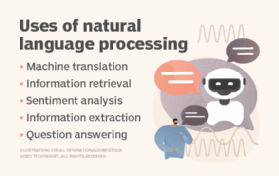
These are some uses for natural language processing.
ChatGPT is a form of generative AI -- a tool that lets users enter prompts to receive humanlike images, text or videos that are created by AI.
ChatGPT is similar to the automated chat services found on customer service websites, as people can ask it questions or request clarification to ChatGPT's replies. The GPT stands for "Generative Pre-trained Transformer," which refers to how ChatGPT processes requests and formulates responses. ChatGPT is trained with reinforcement learning through human feedback and reward models that rank the best responses. This feedback helps augment ChatGPT with machine learning to improve future responses.
Who created ChatGPT?
OpenAI -- an artificial intelligence research company -- created ChatGPT and launched the tool in November 2022. It was founded by a group of entrepreneurs and researchers including Elon Musk and Sam Altman in 2015. OpenAI is backed by several investors, with Microsoft being the most notable. OpenAI also created Dall-E, an AI text-to-art generator.
How does ChatGPT work?
ChatGPT works through its Generative Pre-trained Transformer, which uses specialized algorithms to find patterns within data sequences. ChatGPT originally used the GPT-3 large language model, a neural network machine learning model and the third generation of Generative Pre-trained Transformer. The transformer pulls from a significant amount of data to formulate a response.
Will AI replace jobs? 18 job types that might be affected
27 of the best large language models in 2025
ChatGPT currently provides access to GPT-3.5 and limited access to the GPT-4o language model. ChatGPT Plus provides access to GPT-4 and GPT-4o. GPT-4 can handle more complex tasks compared to GPT-3.5, such as describing photos, generating captions for images and creating more detailed responses up to 25,000 words. ChatGPT Pro users have access to GPT-4.5, a general-purpose model that aims to provide human-like interactions.
ChatGPT uses deep learning, a subset of machine learning, to produce humanlike text throughtransformer neural networks. The transformer predicts text -- including the next word, sentence or paragraph -- based on its training data's typical sequence.
Training begins with generic data, then moves to more tailored data for a specific task. ChatGPT was trained with online text to learn the human language, and then it used transcripts to learn the basics of conversations.
Human trainers provide conversations and rank the responses. These reward models help determine the best answers. To keep training the chatbot, users can upvote or downvote its response by clicking on thumbs-up or thumbs-down icons beside the answer. Users can also provide additional written feedback to improve and fine-tune future dialogue.
LoWhat kinds of questions can users ask ChatGPT?
Users can ask ChatGPT a variety of questions, including simple or more complex questions, such as, "What is the meaning of life?" or "What year did New York become a state?" ChatGPT is proficient with STEM disciplines and can debug or write code. There is no limitation to the types of questions to ask ChatGPT. However, the knowledge cutoff date is late 2023.
How are people using ChatGPT?
ChatGPT is versatile and can be used for more than human conversations. People have used ChatGPT to do the following:
Code computer programs and check for bugs in code.
Compose music.
Draft emails.
Summarize articles, podcasts or presentations.
Script social media posts.
Create titles for articles.
Solve math problems.
Discover keywords for search engine optimization.
Create articles, blog posts and quizzes for websites.
Reword existing content for a different medium, such as a presentation transcript for a blog post.
Formulate product descriptions.
Play games.
Assist with job searches, including writing resumes and cover letters.
Ask trivia questions.
Describe complex topics more simply.
Write video scripts.
Research markets for products.
Generate art.
Unlike other chatbots, ChatGPT can remember various questions to continue the conversation in a more fluid manner.
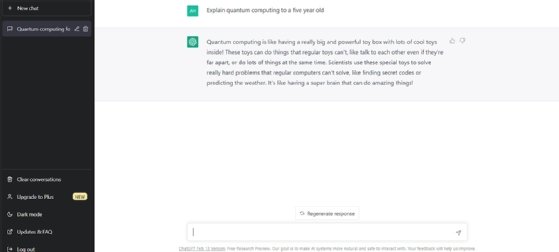
ChatGPT's response when asked to explain quantum computing to a 5-year-old.
What are the benefits of ChatGPT?
Businesses and users are still exploring the benefits of ChatGPT as the program continues to evolve. Some benefits include the following:
Efficiency. AI-powered chatbots can handle routine and repetitive tasks, which can free up employees to focus on more complex and strategic responsibilities.
Cost savings. Using AI chatbots can be more cost-effective than hiring and training additional employees.
Improved content quality. Writers can use ChatGPT to improve grammatical or contextual errors or to help brainstorm ideas for content. Employees can take ordinary text and ask to improve its language or add expressions.
Education and training. ChatGPT can help provide explanations on more complex topics to help serve as a virtual tutor. Users can also ask for guides and any needed clarification on responses.
Better response time. ChatGPT provides instant responses, which reduces wait times for users seeking assistance.
Increased availability. AI models are available around the clock to provide continuous support and assistance.
Multilingual support. ChatGPT can communicate in multiple languages or provide translations for businesses with global audiences.
Personalization. AI chatbots can tailor responses to the user's preferences and behaviors based on previous interactions.
Scalability. ChatGPT can handle many users simultaneously, which is beneficial for applications with high user engagement.
Natural language understanding. ChatGPT understands and generates humanlike text, so it is useful for tasks such as generating content, answering questions, engaging in conversations and providing explanations.
Digital accessibility. ChatGPT and other AI chatbots can assist individuals with disabilities by providing text-based interactions, which can be easier to navigate than other interfaces.
What are the limitations of ChatGPT? How accurate is it?
Some limitations of ChatGPT include the following:
It does not fully understand the complexity of human language. ChatGPT is trained to generate words based on input. Because of this, responses might seem shallow and lack true insight.
Responses can sound like a machine and unnatural. Since ChatGPT predicts the next word, it can overuse words such as the or and. Because of this, people still need to review and edit content to make it flow more naturally, like human writing.
It summarizes but does not cite sources. ChatGPT does not provide analysis or insight into any data or statistics, nor does it provide links to sources unless you specifically request them. ChatGPT might provide statistics but no real commentary on what these statistics mean or how they relate to the topic.
It cannot understand sarcasm and irony. ChatGPT is based on a data set of text.
It might focus on the wrong part of a question and not be able to shift. For example, if you ask ChatGPT, "Does a horse make a good pet based on its size?" and then ask it, "What about a cat?" ChatGPT might focus solely on the size of the animal versus giving information about having the animal as a pet. ChatGPT is not divergent and cannot shift its answer to cover multiple questions in a single response.
It shuns politics. Generally speaking, ChatGPT does not like to get involved in political debates or take sides, although it has been accused of favoritism for certain political viewpoints.